

Sustainability · 2025
In this section50 topics
- Sustainability Policy4 items
- Sustainability Goals & UN SDGs3 items
- Policy Review2 items
- Business Value Chain1 item
- Stakeholder Analysis1 item
- Environmental Policy & Guidelines3 items
- Environmental Policy Review3 items
- Energy — Plan & Guidelines2 items
- Energy — Electricity Consumption1 item
- Energy — Fuel Consumption1 item
- Energy — Targets2 items
- Energy — Performance & Outcomes2 items
- Water — Plan & Guidelines2 items
- Water — Withdrawal, Discharge & Consumption1 item
- Water — Targets2 items
- Water — Performance & Outcomes2 items
- Waste — Plan & Guidelines2 items
- Waste — Generation, Disposal & Recycling1 item
- Waste — Targets2 items
- Waste — Performance & Outcomes2 items
- GHG — Plan & Guidelines2 items
- GHG — Emissions1 item
- GHG — Emissions Verification2 items
- GHG — Principles & Standards1 item
- GHG — Targets1 item
- GHG Targets — Carbon Neutrality1 item
- GHG — Performance & Outcomes2 items
- Environmental Legal Incidents1 item
- Other Environmental Management1 item
- Social Policy & Guidelines3 items
- Social Policy Review3 items
- Human Rights Due Diligence2 items
- Employees — Plan & Guidelines3 items
- Employees — Workforce1 item
- Employees — Remuneration & Provident Fund1 item
- Employees — Training & Development1 item
- Employees — Occupational Health & Safety1 item
- Employees — Labour Relations1 item
- Employees — Employee Representation2 items
- Employees — Targets2 items
- Employees — Performance & Outcomes1 item
- Customers — Plan & Guidelines3 items
- Customers — Satisfaction Results1 item
- Customers — Targets2 items
- Customers — Performance & Outcomes2 items
- Community & Social — Plan & Guidelines3 items
- Community & Social — Targets2 items
- Community & Social — Performance & Outcomes2 items
- Other Social Management1 item
- Law Violation Incidents1 item
Sustainability Policy
Has a Sustainability Policy
Yes
Policy Description
Microleasing Public Company Limited has a policy of driving business with social responsibility (Corporate Social Responsibility) to create sustainable value in the process. This aims to build confidence in the business operations both within and outside the organization, benefiting not only stakeholders but also the environment in the long term.The continuous practices that Microleasing has implemented help enhance its competitiveness and adjust processes according to various factors affecting the business. Microleasing's sustainable practices help reduce impacts on society and the environment, while also building confidence in the organization and promoting a positive image by supporting preventive measures that have positive impacts on the world.
Reporting Scope
Microleasing Public Company Limited has prepared the company's sustainability report to disclose the company's performance in environmental, social, governance, and economic aspects, including those of its subsidiaries. This report covers the operational period from January 1 to December 31, 2025.
Sustainability Policy and Goals
Microleasing Public Company Limited and its subsidiaries recognize the importance of conducting business under good corporate governance. They have established a sustainability policy that considers the impacts on all stakeholders, including employees, customers, partners, alliances, competitors, shareholders, society, communities, and the environment.Including management that focuses on creating quality in 3 areas to develop the business towards sustainability, namely environmental, social, corporate governance and economic aspects.As well as being committed to raising the quality of operations and continuously developing competitiveness.with the objective of using it as a management guideline within the company and its subsidiaries, translating it into concrete business operations. This is aimed at building confidence among all stakeholders, ultimately leading to sustainable value and long-term business success.
Currently, the company focuses on sustainable development in environmental, social, governance, and economic dimensions. They conduct business transparently under a governance system to"To be the leading provider of comprehensive services and consultancy for transport operators and individual customers throughout Thailand."
Policy Document Link
https://www.microleasingplc.com/storage/document/cg-policy/micro-sustainability-policy-th.pdf
Page Number in Report
2
Sustainability Goals & UN SDGs
Has Sustainability Goals
Yes
Goals Description
Microleasing Public Company Limited and its subsidiaries are committedto conducting business operations under principlesof good corporate governance. They have estab-lished policies to develop a model for creatingsustainable value for all stakeholders, encompassingemployees, customers, suppliers, allies, competitors,shareholders, society, communities, and the environment. Through operational strategies, includingshort-term, medium-term, and long-term plans, thecompany has adapted to changes and managedfnancial cost relationships by considering impactfactors. Additionally, sustainable managementguidelines have been implemented to provide de-cision-making information across various projects.These guidelines promote increased transparency,ensuring business is conducted openly with a robustgovernance system and a keen awareness of socialresponsibility. This approach aims to create valuefor all stakeholders, thereby enhancing long-termsustainable business value and reinforcing Microle-asing’s leadership in providing comprehensive usedtruck fnancing services.
UN Sustainable Development Goals
| SDG Goal |
|---|
| Goal 3 Good Health and Well-being |
| Goal 3 Good Health and Well-being |
| Goal 4 Quality Education |
| Goal 4 Quality Education |
| Goal 5 Gender Equality |
| Goal 5 Gender Equality |
| Goal 6 Clean Water and Sanitation |
| Goal 6 Clean Water and Sanitation |
| Goal 7 Affordable and Clean Energy |
| Goal 7 Affordable and Clean Energy |
| Goal 8 Decent Work and Economic Growth |
| Goal 8 Decent Work and Economic Growth |
| Goal 10 Reduce Inequalities |
| Goal 10 Reduce Inequalities |
| Goal 13 Climate Action |
| Goal 13 Climate Action |
| Goal 16 Peace, Justice and Strong Institutions |
| Goal 16 Peace, Justice and Strong Institutions |
Policy Review
Policy Reviewed This Year
Yes
Policy Changed This Year
No
Business Value Chain
Value Chain Description
Primary Activities
Inbound Logistics: The main factors used for lending are capital in the form of equity and borrowed funds from banks, bonds, or stakeholders. For insurance advisory work, it involves coordinating with insurance company partners to obtain suitable products that can help reduce operational risks for customers.
Operations: Developing a diverse range of products or services suitable for the company's retail customers, including creating new service approaches that cover all customer activities to help their businesses grow and enable them to make payments as per the contract. This also includes designing products that match customer risks.
Outbound Logistics: Distributing products and services through various channels, including company branches, intermediaries such as over 400 used truck dealers, more than 280 motorcycle dealers, over 200 agent and broker members, direct marketing to customers, organizing seminars for transport operators, participating in various events, and online channels.
Marketing and Sales: Presenting the company's products and services, including hire purchase loans, personal loans, non-life and life insurance brokerage, by focusing on listening to customer problems or needs to match them with the company's products or services and offering them to customers according to fair service guidelines (Market Conduct).
After-Sales Service: Continuously taking care of customers to ensure they can generate income until the end of the contract, such as providing installment payment inquiries, advice when customers face payment problems, convenient payment channels, and insurance renewal services to reduce risks for customers in case of unforeseen events that may affect their payments. Additionally, there are channels for receiving complaints to ensure maximum customer satisfaction.
Support Activities
Human Resources: Combining ideas, knowledge, and business experience with universal and ethical principles to develop professional personnel with a family-like service mindset. This includes managing compensation, maintaining personnel, transparent and fair recruitment.
Accounting and Finance: Disclosing operational and financial information accurately, transparently, timely, and reliably according to standards. This also includes efficient cost, expense, and liquidity risk management.
Information Technology: Participating in improving various systems to be efficient, fast, and accurate, preventing attacks and leaks of personal information with ISO 27001 standards, and upgrading the company's operations to a fully digital system.
Corporate Governance, Risk Management, and Internal Audit: Acting as a preventive and directive measure to ensure the company's operations comply with laws, regulations, and governance, while emphasizing environmental, social, and governance (ESG) aspects to achieve sustainable growth with all stakeholders.
Stakeholder Analysis
Stakeholder Analysis
| Stakeholder Type | Stakeholders | Stakeholder Expectations | Response to Expectations | Communication Activities |
|---|---|---|---|---|
| Internal stakeholders | 2899 · Description: Suppliers · 2913 · Description: Shareholders · 2921 · Description: Employees · 2923 · Description: Customers | Stakeholder interests, as well as feedback and suggestions, are considered and encouraged. Stakeholders are given the opportunity to participate in expressing their opinions, allowing the company to effectively respond to their needs. Each stakeholder group has different approaches and methods for engagement and relationship building. | In order to be able to respond to needs effectively | 2938 · Description: Visit · 2940 · Description: Social Event · 2941 · Description: Online Communication · 2942 · Description: Internal Meeting · 2943 · Description: External Meeting · 2944 · Description: Annual General Meeting (AGM) · 2945 · Description: Complaint Reception · 2946 · Description: Employee Engagement Survey · 2948 · Description: Training / Seminar |
| External stakeholders | 2894 · Description: Creditor · 2898 · Description: Competitors · 2900 · Description: Business partners · 2902 · Description: Community · 2904 · Description: Investors or investment institutions · 2905 · Description: Analysts · 2913 · Description: Shareholders · 2928 · Description: Society · 2931 · Description: Government agencies and Regulators | Stakeholder interests, as well as feedback and suggestions, are considered and encouraged. Stakeholders are given the opportunity to participate in expressing their opinions, allowing the company to effectively respond to their needs. Each stakeholder group has different approaches and methods for engagement and relationship building. | 2938 · Description: Visit · 2939 · Description: Press Release · 2940 · Description: Social Event · 2941 · Description: Online Communication · 2943 · Description: External Meeting · 2944 · Description: Annual General Meeting (AGM) · 2945 · Description: Complaint Reception · 2947 · Description: Satisfaction Survey · 2948 · Description: Training / Seminar |
Environmental Policy & Guidelines
Has an Environmental Policy
Yes
Policy Description
Environmental Policy
Microleasing Public Company Limited and its affiliated companies, subsidiaries, and joint ventures (hereinafter referred to as "the Company") are committed to and recognize the importance of using natural resources efficiently and sustainably. Consequently, the Company has established an environmental policy to ensure compliance with environmental regulations and guidelines. All employees and stakeholders are required to adhere to and strictly follow this policy. The environmental practices are outlined as follows:
1. Objectives
This environmental policy is established with the objective of providing a framework and guidelines for the Company's business operations in alignment with the commitment to sustainability. The Company is dedicated to a business approach that not only seeks profit but also considers key factors such as Environment, Social, and Governance (ESG). The policy aims to minimize environmental impact and support development aligned with the Sustainable Development Goals (SDGs). The ESG approach helps build the business's credibility by reflecting its responsibility towards stakeholders and showcasing its performance in sustainable business growth.
2. Departments Required to Comply with the Policy
All departments of the Company
3. Guidelines
3.1 Comply with Legal Requirements Strictly adhere to international and local environmental laws and regulations, and take responsibility for any negative environmental impacts that may arise from the organization's operations.
3.2 Support Awareness Building Organize environmental training and education for employees and stakeholders to raise awareness and understanding of climate change, natural resource conservation, and the importance of preventing negative environmental impacts.
3.3 Establish Energy, Resource, and Environmental Management Guidelines and Goals Align the company's internal energy, resource, and environmental management guidelines and goals with international standards to promote sustainable development goals. Emphasize environmental conservation, efficient resource use, reduction of wastewater and waste, and sustainable use of natural resources, energy, and water.
3.4 Support Efficient Waste Management Promote effective waste management to minimize environmental impacts, focusing on reducing excessive usage by always thinking before using (Reduce). Encourage reusing materials (Reuse) and selecting recyclable materials (Recycle) or alternative products efficiently and cost-effectively, following the 3Rs principle.
3.5 Establish an Environmental Management System Integrate an environmental management system as part of business operations. Monitor, assess, report, and evaluate environmental management performance to ensure compliance with legal and other related requirements. Examples include reducing electricity consumption in business activities and supporting business operations, promoting awareness of efficient electricity and water use, minimizing waste, reducing paper usage by switching to electronic documents, and decreasing travel for meetings by using video conferencing. The Company will also organize at least one Big Cleaning Day per year to manage workplace resources, clean the workplace, reduce consumables, and properly separate and dispose of materials that are no longer beneficial to the workplace.
3.6 Disclose Information on Efficient and Cost-Effective Use of Natural Resources Disclose information on the efficient and cost-effective use of natural resources. Engage with stakeholders to discuss performance and environmental issues, and establish key performance indicators and strategies to meet operational goals according to stakeholder expectations.
3.7 Collaborate with Government Agencies, Educational Institutions, Communities, and Other Organizations
Foster collaboration with government agencies, educational institutions, communities, and other organizations to jointly address environmental issues and climate change.
Environmental Guidelines
| Guideline |
|---|
| Electricity Management |
| Fuel Management |
| Renewable/Clean Energy Management |
| Water Management |
| Waste Management |
| Greenhouse Gas and Climate Change Management |
Environmental Policy Review
Policy Reviewed This Year
Yes
Review Details
Guidelines
3.1 Comply with Legal Requirements Strictly adhere to international and local environmental laws and regulations, and take responsibility for any negative environmental impacts that may arise from the organization's operations.
3.2 Support Awareness Building Organize environmental training and education for employees and stakeholders to raise awareness and understanding of climate change, natural resource conservation, and the importance of preventing negative environmental impacts.
3.3 Establish Energy, Resource, and Environmental Management Guidelines and Goals Align the company's internal energy, resource, and environmental management guidelines and goals with international standards to promote sustainable development goals. Emphasize environmental conservation, efficient resource use, reduction of wastewater and waste, and sustainable use of natural resources, energy, and water.
3.4 Support Efficient Waste Management Promote effective waste management to minimize environmental impacts, focusing on reducing excessive usage by always thinking before using (Reduce). Encourage reusing materials (Reuse) and selecting recyclable materials (Recycle) or alternative products efficiently and cost-effectively, following the 3Rs principle.
3.5 Establish an Environmental Management System
Integrate an environmental management system as part of business operations. Monitor, assess, report, and evaluate environmental management performance to ensure compliance with legal and other related requirements. Examples include reducing electricity consumption in business activities and supporting business operations, promoting awareness of efficient electricity and water use, minimizing waste, reducing paper usage by switching to electronic documents, and decreasing travel for meetings by using video conferencing. The Company will also organize at least one Big Cleaning Day per year to manage workplace resources, clean the workplace, reduce consumables, and properly separate and dispose of materials that are no longer beneficial to the workplace.
3.6 Disclose Information on Efficient and Cost-Effective Use of Natural Resources
Disclose information on the efficient and cost-effective use of natural resources. Engage with stakeholders to discuss performance and environmental issues, and establish key performance indicators and strategies to meet operational goals according to stakeholder expectations.
3.7 Collaborate with Government Agencies, Educational Institutions, Communities, and Other Organizations
Foster collaboration with government agencies, educational institutions, communities, and other organizations to jointly address environmental issues and climate change
Policies & Guidelines Changed
| Change |
|---|
| Electricity Management |
| Fuel Management |
| Renewable/Clean Energy Management |
| Water Management |
| Waste Management |
| Greenhouse Gas and Climate Change Management |
Energy — Plan & Guidelines
Has an Energy Management Plan
Yes
Plan Description
• The Company promotes energy conservation among employees by encouraging the use of electrical equipment only when necessary and turning off equipment after use. Additionally, the Company disseminates information on energy-saving practices and efficient use of resources, purchases energy-saving electrical equipment with a rating of 5, inspects electrical equipment, and replaces damaged or malfunctioning equipment.
• In 2022, the Company installed solar energy panels with a capacity of 44.2 KW, 3 Phase, with each panel being 540 Watt, totaling 82 panels. The production of electricity began on August 1, 2022. Initially, the rainy season affected the electricity generation, but it has since improved. Nevertheless, the Company aims to reduce electricity costs and continues to emphasize energy conservation in the workplace, such as turning off lights and air conditioning during lunch breaks.
Energy — Electricity Consumption
Electricity Consumption
| Metric | Current Year | Previous Year | Two Years Ago |
|---|---|---|---|
| Total electricity consumption within the organization (Kilowatt-Hours) | 291,263 | 379,988 | 450,556 |
| Electricity purchased for consumption from non-renewable energy sources (Kilowatt-Hours) | 245,993 | 331,818 | 409,276 |
| Electricity purchased or generated for consumption from renewable energy sources (Kilowatt-Hours) | 45,270 | 48,170 | 41,280 |
Energy — Fuel Consumption
Fuel Consumption
| Metric | Current Year | Previous Year | Two Years Ago |
|---|---|---|---|
| Crude oil (Barrels) | 0 | 0 | 0 |
| Coal (Metric tonnes) | 0 | 0 | 0 |
| Jet fuel (Litres) | 0 | 0 | 0 |
| Diesel (Litres) | 4,627.66 | 5,052.56 | 0 |
| Gasoline (Litres) | 63,235.4 | 67,595.64 | 0 |
| Fuel oil (Litres) | 0 | 0 | 0 |
| Natural gas (Standard cubic feet) | 0 | 0 | 0 |
| LPG (Kilograms) | 0 | 0 | 0 |
| Steam (Metric tonnes) | 0 | 0 | 0 |
Energy — Targets
Has Set Targets
Yes
Targets
| Target | Base Year | Base Year Value | Target Year | Target Change (%) | Unit |
|---|---|---|---|---|---|
| Reduction of electricity purchased for consumption | 2,024 | 285,518 | 2,025 | 5 | Kilowatt-hour |
| Reduction of fuel consumption | 2,024 | 72,648.2 | 2,025 | 5 | Litres |
Energy — Performance & Outcomes
Has Performance Results
No
Performance Description
The company achieved a 13.51% reduction in energy consumption through employee energy-saving initiatives and conservation measures:
Improving Office Energy Efficiency: Utilizing LED lighting, automatic systems, and enhancing the efficiency of electrical equipment.
Setting Appropriate Air Conditioning Temperature: Maintaining a temperature of 25-26 degrees Celsius and regularly cleaning air filters.
Installing Solar Panels: Using solar energy to reduce reliance on fossil fuel-generated electricity.
Encouraging Employees to Turn Off Electrical Equipment When Not in Use: Including computers, printers, and other devices.
Conducting Energy Conservation Training and Awareness Programs: Engaging employees in reducing energy consumption.
Organizing Corporate Carbon Footprint Reduction Projects: Such as competitions to reduce electricity use within various departments.
Water — Plan & Guidelines
Has a Water Management Plan
Yes
Plan Description
The Company's water management plan covers the efficient use and conservation of water resources to reduce costs, minimize environmental impact, and enhance business sustainability. The details of the water resource management plan are as follows:
1. Assessment of the Water Situation Within the CompanySources of Water Used: Identify the sources of water the company uses, such as tap water, groundwater, or surface water.Water Usage Volume: Monitor the volume of water used in each department or process.
2. Reducing Water Usage and Enhancing EfficiencyImprove Production Processes: Reduce water usage by implementing water-saving measures to decrease the amount of water used.Employee Education: Promote awareness among employees about efficient water usage.
• Disseminate information on water-saving practices and efficient use of resources.
• Encourage the use of water only when necessary and ensure equipment is turned off after use.
• Promote not disposing of tissue paper or other items into the toilet.
Water — Withdrawal, Discharge & Consumption
Water Withdrawal, Discharge & Consumption
| Metric | Current Year | Previous Year | Two Years Ago |
|---|---|---|---|
| Total water withdrawal (Cubic meters) | 4,600 | 4,709.3 | 6,624.15 |
| Total water withdrawal by third-party water (Cubic meters) | 4,600 | 4,709.3 | 6,624.15 |
| Total water withdrawal by surface water (Cubic meters) | 0 | 0 | 0 |
| Total water withdrawal by groundwater (Cubic meters) | 0 | 0 | 0 |
| Total water withdrawal by seawater (Cubic meters) | 0 | 0 | 0 |
| Total water withdrawal by produced water (Cubic meters) | 0 | 0 | 0 |
| Percentage of wastewater treated before discharge (%) | 0 | 0 | 0 |
| Total water discharge (Cubic meters) | 0 | 0 | 0 |
| Total water discharge to third-party water (Cubic meters) | 0 | 0 | 0 |
| Total water discharge to surface water (Cubic meters) | 0 | 0 | 0 |
| Total water discharge to groundwater (Cubic meters) | 0 | 0 | 0 |
| Total water discharge to seawater (Cubic meters) | 0 | 0 | 0 |
| Total water consumption (Cubic meters) | 3,460 | 4,709.3 | 6,624.15 |
| Recycled water (Cubic meters) | 0 | 0 | 0 |
Water — Targets
Has Set Targets
Yes
Targets
| Target | Base Year | Base Year Value | Target Year | Target Change (%) | Unit |
|---|---|---|---|---|---|
| Reduction of water withdrawal | 2,023 | 6,624.15 | 2,025 | 3 | Cubic meters |
Water — Performance & Outcomes
Has Performance Results
No
Performance Description
After implementing the water management plan, the Company can measure and evaluate the outcomes and success from various aspects, such as water usage reduction. The results can be summarized as follows:
• Reduction in Water Usage: 28.91% reduction achieved through water-saving measures, such as disseminating information on water-saving practices and efficient use of resources.
• Economic Benefits: Reduced water expenses by 37,145 Baht.
Waste — Plan & Guidelines
Has a Waste Management Plan
Yes
Plan Description
The Company promotes awareness among employees regarding waste disposal and encourages understanding of proper waste management in line with international practices to reduce the amount of waste and mitigate environmental impacts, pollution, and disease in the office. The Company's public relations efforts include the following:
• Promote awareness among employees regarding waste disposal
• Educate employees about proper waste management, such as teaching them how to separate waste
• Encourage employees to separate waste before disposing of it in designated areas
• Reduce the amount of hazardous waste in the overall waste stream through proper waste separation
Waste — Generation, Disposal & Recycling
Waste Generation, Disposal & Recycling
| Metric | Current Year | Previous Year | Two Years Ago |
|---|---|---|---|
| Total waste generated (Kilograms) | 6,896.5 | 5,010 | 5,245.45 |
| Non-hazardous waste (Kilograms) | 6,896.5 | 5,010 | 5,245.45 |
| Non-hazardous waste - Landfilling (Kilograms) | |||
| Non-hazardous waste - Incineration (with energy recovery) (Kilograms) | |||
| Non-hazardous waste - Incineration (without energy recovery) (Kilograms) | |||
| Non-hazardous waste - Other disposal operations (Kilograms) | |||
| Hazardous waste (Kilograms) | |||
| Hazardous waste - Landfilling (Kilograms) | |||
| Hazardous waste - Incineration (with energy recovery) (Kilograms) | |||
| Hazardous waste - Incineration (without energy recovery) (Kilograms) | |||
| Hazardous waste - Other disposal operations (Kilograms) | |||
| Total reused/recycled waste (Kilograms) | 6,896.5 | 4,607.19 | 5,245.45 |
| Reused/Recycled non-hazardous waste (Kilograms) | 6,896.5 | 4,607.19 | 5,245.45 |
| Reused non-hazardous waste (Kilograms) | |||
| Recycled non-hazardous waste (Kilograms) | 6,896.5 | 4,607.19 | 5,245.45 |
| Reused/Recycled hazardous waste (Kilograms) | |||
| Reused hazardous waste (Kilograms) | |||
| Recycled hazardous waste (Kilograms) |
Waste — Targets
Has Set Targets
Yes
Targets
| Waste Type | Disposal Approach | Target | Base Year | Target Year | Target Change (%) | Unit |
|---|---|---|---|---|---|---|
| Non-hazardous waste | 2760 · Description: Landfilling | Reduce waste volume | 2,023 | 2,025 | 5 | Kilograms |
Waste — Performance & Outcomes
Has Performance Results
No
Performance Description
The Company has implemented measures to reduce waste and manage waste efficiently to minimize environmental impact. The results of the operations and outcomes can be summarized as follows:Overall Waste Reduction:
• 10% reduction in waste achieved through promoting employee awareness of proper waste management in line with international practices, reducing waste and its environmental impact, and mitigating pollution and diseases in the office.
• Encouraging the Use of Eco-friendly Containers: Promoted employees to switch from using plastic containers to biodegradable lunch boxes or packaging as a way to reduce plastic waste and promote environmental sustainability.
GHG — Plan & Guidelines
Has a GHG Management Plan
No
Plan Description
In 2022, the Company transitioned to using renewable energy, such as solar energy, by installing solar energy panels with a capacity of 44.2 KW, 3 Phase, with each panel being 540 Watt, totaling 82 panels. The Solar Roof system was put into operation and has helped reduce greenhouse gas emissions, specifically CO2, by 46.30 tons, which is equivalent to planting 76 trees.
GHG — Emissions
GHG Emissions
| Metric | Current Year | Previous Year | Two Years Ago |
|---|---|---|---|
| Total GHG emissions (Metric tonnes of carbon dioxide equivalent) | 440 | 169.4 | 0 |
| Total greenhouse gas emissions 1 (Metric tonnes of carbon dioxide equivalent) | 137 | 0.2 | 0 |
| Total greenhouse gas emissions 2 (Metric tonnes of carbon dioxide equivalent) | 124 | 169.2 | 0 |
| Total greenhouse gas emissions 3 (Metric tonnes of carbon dioxide equivalent) | 179 | 0 | 0 |
GHG — Emissions Verification
Emissions Verified by a Third Party
Yes
Verifying Body
3180
GHG — Principles & Standards
Principles & Standards Applied
| Standard |
|---|
| 2671 |
| 2676 |
GHG — Targets
Has Set GHG Targets
Yes
GHG Targets — Carbon Neutrality
Carbon Neutrality Targets
| Emission Scope | Carbon Neutrality Certified | Certifying Body | Target Year | Target Change (%) | Unit |
|---|---|---|---|---|---|
| 2715 | Y | Thailand Greenhouse Gas Management Organization | 2,025 | 10 | Metric tonnes of carbon dioxide equivalent |
GHG — Performance & Outcomes
Has Performance Results
No
Performance Description
In 2025, the Company prepared the data to stablish a baseline year as a suitable starting point for measuring GHG reduction and key performance indicators, such as CO2e emissions.Based on the collected data, the Company's greenhouse gas emissions amounted to 169.40 tonCO2e
Environmental Legal Incidents
Legal Violation Incidents
| Metric | Current Year | Previous Year | Two Years Ago |
|---|---|---|---|
| Number of cases or incidents of legal violations or negative environmental impact (cases) | 0 | 0 | 0 |
Other Environmental Management
Plan Description
Environmental Action Plan
Waste Reduction
The Company has a campaign to promote environmental awareness amongst employees specifically the knowledge of waste management and reduction by educating employees to separate their waste before disposing it in the bin, and provide different kinds of bin for each type of waste that is inline with the international standards, the company had internally publicized the following
Campaigning amongst employees of a good mindset and knowledge of waste management
Encouraging employees to understand proper waste management, educating them to separate waste
Campaigning for employees to separate different kind of waste before disposing them in designated place
Let employees understand the correct waste management, such as educating employees to know how to separate waste.
Campaign for employees to separate waste types before disposing them in the places that have been prepared at each point.
By separating waste, it reduces the amount of hazardous waste from solid waste that has to be sent
to landfill.
Develop work systems by focusing on electronic transactions.
Publicize content to educate employees of ways to save paper and use resources efficiently.
Digitizing working process within the organization, choose online channels such as SMS, E-Mail, Line@, Facebook instead using paper when dealing with external agencies.
Reduce the operating process such as sending of warning paper to ‘outsource’ instead of using the company own operation
The operation enables the company to reduce the amount of paper usage in the company. This helps with the operating expense, including the cost of paper, printing ink, document delivery, and document storage, and also reduce paper waste. In terms of operation, these helps with the work efficiency, helping reduce time searching for documents, reduce the risk of data loss when sending out document. For customers, this helps customers save time, and improve convenience, instead of having the fill out large amount of paperwork, satisfying them with online process in the digital age.
Campaign to promote energy saving
Alternative Energy – Solar Cell
Since 2020, the company had faced with COVID_19, forcing some employees to have to work from home, and in 2022, the company has installed Solar System in the company’s headquarters allowing the company to save on electric cost as shown However, the company has a goal to maintain electric consumption by encouraging employees to save electricity by turning off electrical devices, such as Air Conditioning, Light, and computer screen during lunch time.
Human Rights Due Diligence
Conducts Human Rights Due Diligence
Yes
Due Diligence Description
The company focused on the development of a comprehensive Human Rights auditing process to ensure that the operations of the company will violate human rights throughout the value chain. By analyzing risk issues, assessing opportunities and impacts, as well as setting guidelines for risk prevention, problem solving mitigation and mitigation of impact in case of violations of human rights, by disclosing such operations in the company annual report.
Human Rights Due Diligence (HRDD):
The company respects the human rights of all stakeholders and is committed to treating all stakeholders fairly and appropriately throughout the value chain in accordance with universal human rights principles. It adheres to international laws and standards, and its operational framework is aligned with the United Nations Guiding Principles on Business and Human Rights (UNGP) and the OECD Due Diligence Guidance for Responsible Business Conduct.
Neglecting human rights impacts can lead to a loss of trust from stakeholders or even social backlash, which may affect the company's ability to conduct business and its long-term performance. Therefore, the company prioritizes comprehensive human rights governance and fostering collaboration with all sectors to create a just and sustainable development path for all parties. The company has established a process for monitoring and conducting comprehensive human rights due diligence, with the following key aspects:
Human Rights Risk Assessment and Impact
The company conducts a human rights risk assessment every two years and reviews risk issues annually. This integrates the identification and assessment of human rights violation risks into various risk assessment processes that each unit must perform according to its responsibilities, such as Environmental Impact Assessment (EIA) in project development, environmental issue identification and assessment, and occupational safety and health hazard and risk assessment according to ISO standards. In 2024, the company underwent a new, comprehensive sustainability assessment, simultaneously identifying human rights risks throughout the value chain. This was then assessed in accordance with the United Nations Guiding Principles on Business and Human Rights and the OECD Due Diligence Guidance for Responsible Business Conduct.
Scope of Risk Assessment
The company mandates a human rights violation risk assessment covering all areas of its operations and all business activities in the value chain, representing 100% coverage. This includes activities performed directly by the company and those arising from participation or business relationships within the supply chain.
Identification of Human Rights Risks
The company identifies all actual or potential human rights issues related to its business activities and business relationships throughout the value chain. Using various data collection methods, the company analyzes these data to identify relevant human rights risks—issues that have already occurred or may not yet occur—considering the rights of all stakeholders, including employees, customers, business partners, contractors or external service providers, local communities, and children and vulnerable groups, the elderly, people with disabilities, and workers in the processes.
Key Human Rights Risk Issues
The company identified a total of 14 human rights risk issues related to its operations throughout the supply chain. The level of human rights risk was assessed using criteria for evaluating the severity of the impact on stakeholders, based on the scale of impact, the number of affected individuals (scope), and the ability to remedy the impact (irremediable character), along with the likelihood of occurrence.
Risk Level Assessment
The company assesses risk using two dimensions: the severity of impact (severity), considered from scale, scope, irremediability, and likelihood. The risks are prioritized in a 4x4 Human Rights Risk Matrix, categorized into three levels: high risk, medium risk, and low risk.
High-risk Level refer isignificant human rights risks that require immediate attention, along with urgent preventative or mitigating measures. | |
Medium-risk level refers to human rights risk issues that are currently managed and whose impacts can be mitigated to some extent, but additional measures are needed to improve their effectiveness. | |
Low risk level refers to human rights risk issues for which current preventive or control measures are adequately in place, but regular monitoring of changes is still necessary. |
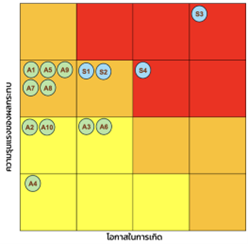
Risks from the company's operations. | |
Risks from operations in the value chain. |
A1 Employee health and safety.
A2 Employment conditions of employees.
A3 Discrimination and inequality in the workplace.
A4 Freedom and bargaining.
A5 Community health and safety.
A6 Environmental impact on the community.
A7 Quality of service and products.
A8 Quality, health, and safety of customers.
A9 Personal data, privacy, and data security.
A10 Security of business partners and external service providers.
S1 The health and safety of workers or related parties of business
partners or external service providers.
S2 Employment conditions of workers for business partners and external service providers.
S3 Health and safety of the surrounding community.
S4 Environmental impact on the community.
Employees — Plan & Guidelines
Has an Employee Management Plan
Yes
Plan Description
1. The Company has established a structured human resource management plan covering talent acquisition, employee development, retention of high-potential employees, and succession planning. During the past year, the Company has refined its organizational structure to align with business strategies and implemented digital systems to enhance efficiency and transparency in workforce management.
2. The Company adopts a fair and competitive compensation policy based on employees’ competencies, experience, performance, and internal equity. Compensation structures are regularly reviewed to align with market conditions and to motivate employees effectively.
3. The Company places strong emphasis on continuous employee development by providing training programs covering both technical (hard skills) and managerial (soft skills), including leadership development, to support long-term organizational growth.
4.The Company fosters an open and inclusive work environment by promoting employee engagement initiatives, encouraging two-way communication, and actively listening to employee feedback to enhance engagement and job satisfaction.
5.The Company ensures fair and equal treatment of migrant workers in full compliance with applicable laws and regulations. Proper employment documentation is maintained, and appropriate welfare is provided without discrimination.
6.The Company strictly prohibits child labor and fully complies with labor laws. Age verification processes are implemented prior to employment to prevent any violation of human rights.
Plan Areas
| Plan Area |
|---|
| Fair employee compensation |
| Employee training and development |
| Promoting employee relations and participation |
| Migrant/foreign labor |
| Child labor |
| Occupational health and safety in workplace |
Employees — Workforce
Workforce Data
| Metric | Current Year | Previous Year | Two Years Ago |
|---|---|---|---|
| Total number of employees (Persons) | 149 | 177 | 245 |
| Number of male employees (Persons) | 60 | 67 | 101 |
| Number of female employees (Persons) | 89 | 110 | 144 |
| Total employment of disabled persons (people) | 3 | 3 | 2 |
| Total disabled employees (people) | 1 | 1 | 1 |
| Total male disabled employees (people) | 0 | 0 | 0 |
| Total female disabled employees (people) | 1 | 1 | 1 |
| Total disabled workers who are non-employee (people) | 2 | 2 | 1 |
| Contributions to the fund for promoting and improving the quality of life for disabled persons | 1 | 1 | 1 |
| Total number of male employees in operational level (Persons) | 47 | 53 | 72 |
| Total number of male employees in management level (Persons) | 8 | 9 | 22 |
| Total number of male employees in executive level (Persons) | 5 | 5 | 7 |
| Total number of female employees in operational level (Persons) | 88 | 106 | 114 |
| Total number of female employees in management level (Persons) | 1 | 4 | 29 |
| Total number of female employees in executive level (Persons) | 0 | 0 | 1 |
Employees — Remuneration & Provident Fund
Remuneration & Provident Fund
| Metric | Current Year | Previous Year | Two Years Ago |
|---|---|---|---|
| Total disabled employees (people) | 77,359,471.39 | 111,178,031.4 | 135,911,688.68 |
| Total male employee remuneration (Baht) | 39,635,886.1 | 58,781,567.71 | 74,471,768.7 |
| Total female employee remuneration (Baht) | 37,723,585.29 | 52,396,463.69 | 61,439,919.98 |
| Number of employees eligible to participate in PVD (persons) | 149 | 177 | 245 |
| Total number of employees joining employee provident fund (Persons) | 116 | 159 | 147 |
| Percentage of total number of employees joining employee provident fund to total number of employees (%) | 77.85 | 89.83 | 60 |
| Number of PVD members / Total eligible employees (%) | 77.85 | 89.83 | 60 |
| Total amount of provident fund contributed by the Company (Baht) | 990,010.8 | 1,321,524.4 | 117,109.8 |
| Total amount of provident fund contributed by employee (baht) |
Employees — Training & Development
Training Data
| Metric | Current Year | Previous Year | Two Years Ago |
|---|---|---|---|
| Average employee training hours (Hours / Person / Year) | 6 | 6 | 5.95 |
| Employee development and training expenses (baht) | 94,141 | 58,610 | 1,082,478 |
Employees — Occupational Health & Safety
Occupational Health & Safety Data
| Metric | Current Year | Previous Year | Two Years Ago |
|---|---|---|---|
| Total number of lost time injury incidents by employees (Cases) | 0 | 0 | 0 |
Employees — Labour Relations
Labour Relations Data
| Metric | Current Year | Previous Year | Two Years Ago |
|---|---|---|---|
| Total voluntary resignations (Persons) | 34 | 73 | 65 |
| Male employees who voluntary resigned (Persons) | 9 | 37 | 29 |
| Female employees who voluntary resigned (Persons) | 25 | 36 | 36 |
| Percentage of employee turnover leaving the Company voluntarily (%) | 22.82 | 41.24 | 26.53 |
| Evaluation result of employee engagement | 1 | 1 | 1 |
Employees — Employee Representation
Employees Are Represented Collectively
Yes
Forms of Representation
| Form |
|---|
| Welfare committee |
Employees — Targets
Has Set Employee Targets
Yes
Targets
| Indicator | Target Areas | Base Year | Target Year | Target Year — Description |
|---|---|---|---|---|
| Key Performance Indicator (KPI) | 2983 · Description: Fair employee compensation · 2984 · Description: Employee training and development · 2985 · Description: Promoting employee relations and participation | 2,025 | 2,025 | Set criteria appropriate to each person's characteristics. |
Employees — Performance & Outcomes
Has Performance Results
No
Customers — Plan & Guidelines
Has a Customer Management Plan
Yes
Plan Description
1. Developing satisfaction and strengthening relationships with customers The Company has policies that prioritize customer satisfaction, build trust and belief in fast and excellent service to satisfy customers, which is a factor that will contribute to the company’s success. The company has an intention to seek more efficient ways to meet the needs of customers.
2. Maintaining customer personal information There is a system to store customer information securely, and measures to maintain customers confidentiality. Information of customer and of the organization will not be disclosed or passed out, unless consent is validated, or is required by the law. Such information will not be used for the benefit of oneself or others wrongfully.
Plan Areas
| Plan Area |
|---|
| Responsible production and services for customers |
| Communication of product and service impacts to customers/consumers |
| Development of customer satisfaction and customer relationship |
| Protection of customer personal information |
Customers — Satisfaction Results
Customer Satisfaction Results
| Metric | Current Year | Previous Year | Two Years Ago |
|---|---|---|---|
| Evaluation results of customer satisfaction | 1 | 1 | 1 |
Customers — Targets
Has Set Customer Targets
Yes
Targets
| Indicator | Target Areas | Base Year | Target Year | Target Year — Description |
|---|---|---|---|---|
| (%) Evaluate customer satisfaction | 3007 · Description: Responsible production and services for customers · 3008 · Description: Communication of product and service impacts to customers/consumers · 3009 · Description: Development of customer satisfaction and customer relationship · 3010 · Description: Consumer data privacy and protection | 2,024 | 2,024 | Level of satisfaction 5 = (Excellent)
Level of satisfaction 4 = (Good)
Level of satisfaction 3 = (Neutral)
Level of satisfaction 2 = (Poor)
Level of satisfaction 1 = (Very Poor) |
| (%) Evaluate customer satisfaction | 3009 · Description: Development of customer satisfaction and customer relationship · 3010 · Description: Consumer data privacy and protection | 2,024 | 2,025 | Level of satisfaction 5 = (Excellent)
Level of satisfaction 4 = (Good)
Level of satisfaction 3 = (Neutral)
Level of satisfaction 2 = (Poor)
Level of satisfaction 1 = (Very Poor) |
Customers — Performance & Outcomes
Has Performance Results
Yes
Performance Description
The company provide Customer Relationship Management Project aimed to continuously develop relations with customer by understanding and meeting customer demand and creating good experiences between the company and customers before,and after service to crete business bonding that can make long-term revenue, In 2025 has level of satisfaction at the average of 95.0 .
However, the company would take result of customer assessment and suggestion to analyze and plan to enhance the quality of services.
Community & Social — Plan & Guidelines
Has a Community & Social Plan
Yes
Plan Description
Corporate Social Responsibility (CSR)
Plan Areas
| Plan Area |
|---|
| Education |
| Occupational health, safety, health, and quality of life |
| Disadvantaged and vulnerable groups |
| Reducing inequality and promoting social equality |
Community & Social — Targets
Has Set Community & Social Targets
Yes
Targets
| Indicator | Target Areas | Base Year | Target Year | Target Year — Description |
|---|---|---|---|---|
| Participation in the community | 3037 · Description: Education · 3041 · Description: Occupational health, safety, health, and quality of life · 3042 · Description: Disadvantaged and vulnerable groups | 2,024 | 2,024 | Organizations that support educational or community development projects |
| Number of participants in the TSM (Transport Safety Manager) training program. | 3036 · Description: Employment and professional skill development | 2,025 | More than 50 clients registered for the training, with 60 actual participants. |
Community & Social — Performance & Outcomes
Has Performance Results
Yes
Performance Description
Award for organizations with outstanding results in promoting social responsibility in the business sector at the provincial level
Other Social Management
Plan & Outcomes — Description
Shareholder Practices and Responsibilities
The Company has a policy to treat all shareholders equally with honesty, integrity, and careful attention, following the principles set by law and relevant government agencies. Shareholder meetings are conducted openly, transparently, and fairly, with all shareholders having equal rights as follows:
4.1 The right to receive regular and timely information on performance and management policies.
4.2 The right to receive equal profit sharing.
4.3 The right to attend shareholder meetings to express opinions on the appointment or removal of directors, the appointment of auditors, and to participate in decision-making on significant changes, including the right of minority shareholders to propose meeting agendas or nominate individuals for independent director positions.
4.4 The right to receive information on related transactions.
4.5 Perform duties towards all shareholders with honesty and fairness.
4.6 Aim to manage the Company for stable growth, creating sustainable returns for shareholders, and regularly report the Company's status and future prospects, both positive and negative, with sufficient supporting reasons.
Law Violation Incidents
Law Violation Incidents
| Metric | Current Year | Previous Year | Two Years Ago |
|---|---|---|---|
| The total number of cases or incidents of significant violations of laws or regulations regarding social and human rights (Cases) | 0 | 0 | 0 |
| The total number of cases or incidents that cause significant labor disputes (Cases) | 0 | 0 | 0 |
| The total number of cases or complaints related to consumer rights violations (Cases) | 0 | 0 | 0 |
| The total number of cases or complaints related to partner rights violations (Cases) | 0 | 0 | 0 |
| The total number of cases or incidents that cause disputes with the community/society (Cases) | 0 | 0 | 0 |
| The total number of cases or incidents related to cyber security or customer data breaches (Cases) | 0 | 0 | 0 |
| The total number of cases or incidents related to safety and occupational health at work (Cases) | 0 | 0 | 0 |