

MD&A · 2025
In this section4 topics
Overview of Operations
Overview of Operations
Micro Leasing (Public) Company Limited was established on November 7, 1994, to provide hire purchase loan services for used trucks. The primary target group was individuals or legal entities who wanted to purchase used trucks for business operations. In the current year, the Company has developed a strategy to expand its business by offering new services including hire purchase for motorcycles, retail loans and other financial services to meet the loan demands of both existing and new customers. Additionally, the Company has contributed to its subsidiaries, which are as follows.
1) Micro Insured Broker Co., Ltd., primarily operated as a non-life and life insurance broker for customers who use hire-purchase services with the Company and its subsidiaries. On 8 October 2020, it was registered with a capital of Baht 3 million, with 99.99% of the share held by the Company. The Business began operations in year 2022.
2) Micro Fin Co., Ltd. primarily operated the retail loan business. On 20 January 2022, it was registered with a capital of Baht 50 million, with 99.99% of the share held by the Company. The Business began operations in year 2023.
3) Micro Plus Co., Ltd. primarily operated hire purchase for motorcycles. On 23 March 2022, it was registered with capital of Baht 400 million, with 51.0% of the share held by the Company. The Business began operations in year 2022.
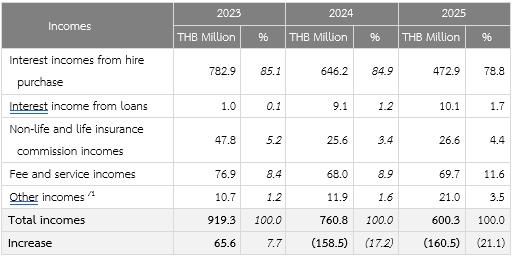
Regarding the performance, the Company and its subsidiaries generated total income of Baht 919.3 million, a decrease of 17.2% compared to the previous year. The main source of income is interest income from hire purchase service, amounting to Baht 646.1 million, accounted for 85.2% of the total income. The subsidiaries increased in interest income from hire purchase for motorcycles, in line with the increase in the proportion of new motorcycle hire purchase loans, which have a higher interest rate compared to hire purchase for trucks. However, interest income from truck hire purchase loans decreased due to the company’s stricter screening of new loan applications, which resulted in a reduced loan portfolio. As a result, service fees and commissions from vehicle insurance and credit protection insurance also decreased. Additionally, Micro Fin Co., Ltd. began providing loans, resulting in increased income interest from lend activities.
The Company and its subsidiaries had increased cost and operating expenses amounting to Baht 937.2 million, a decreased by 7.9% compared to the previous year. There are included selling and administration expenses, expected credit loss, loss from asset foreclosed and financial costs, which represent 32.7%, 16.8%, 32.5% and 18.0%, respectively. The Company and its subsidiaries reduced selling and administration expenses in employee salaries, transportation and communication expenses and debt collection expenses. Additionally, the Company recorded allowance for expected credit loss, which aligns with the decrease in the second-hand truck hire purchase loan portfolio. And the economic slowdown as affect to the Company and its subsidiaries seized collateral from receivable, while the market price of second-hand trucks decreased, resulting in an increase in losses from disposal of assets foreclosed. As a result, the Company and its subsidiaries reported a Net loss attributable to the company for the year 2024 amounting to 153.1 million Baht.
Operating Results & Financial Condition
Operating Results & Profitability
Revenue
Table 1 The Company and its subsidiaries’ income structure in 2023 - 2025 are as follows:
/1 Other incomes of the Company and its subsidiaries included gain on sales of fix assets and income interests form deposit, etc.
• Interest incomes from hire purchase
Interest incomes from hire purchase was interest income generated from the hire purchase loan service for various types of used trucks and new motorcycles. Interest incomes are recognized as income in accordance with the installment payment, using the effective interest rate method over the lease term, net of direct incomes and expenses initially incurred from the hire purchase service such as front-end fee, commission fee paid to dealer who introduce hire purchase loan customer to the Company and its subsidiaries and commission fee for employee. These direct income and expenses are amortized using the effective interest rate method throughout the contract period as same as interest income recognition.
Table 2 Summary interest income from hire purchase
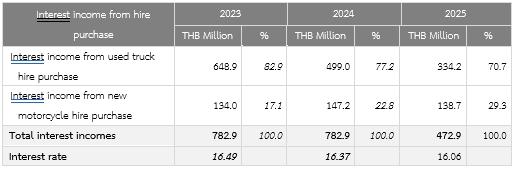
Table 3 The Company and its subsidiary’s interest incomes from hire purchase classified by type of collaterals as follows:
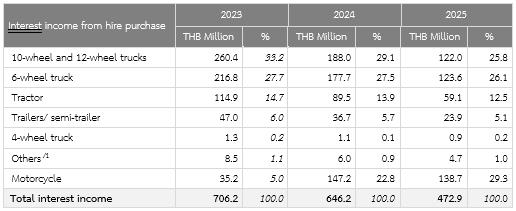
/1 Others include water trucks, liquid trucks, special trucks such as animal feed trucks (silos) or hazardous materials etc.
• Non-life and life insurance commission incomes
Commission income from non-life and life insurance was income from selling insurance to customers who use hire purchase services with the Company and its subsidiary. The receivables can include the value of non-life and life insurance in the with the value of hire-purchase receivables. Therefore, the growth of non-life and life insurance commission incomes will follow the same direction as the growth of hire purchase loan of the Company and its’ subsidiaries.
• Fee and service incomes
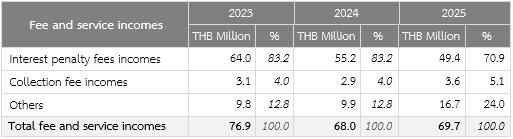
Fee and service incomes of the Company and its’ subsidiaries consist of interest penalty fees, debt collection and follow-up fees, and litigation fees, These will be recognized as fee and service incomes after the hire-purchase contract is executed, as follows:
Table 4 Fee and service incomes
Operation expenses
Table 5 The Company and its subsidiaries’ operating expenses structure in 2023 – 2025, details as follows:
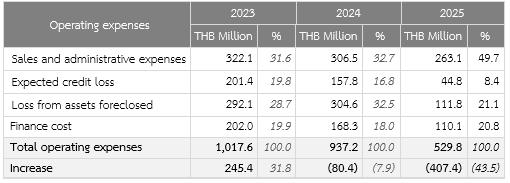
Total operating expenses of the Company and its subsidiaries for the years 2023 – 2025 amounted to Baht 1,017.6 million, Baht 937.2 million and Baht 529.8 million, respectively. There consist of selling and administrative expenses, expected credit loss, loss from assets foreclosed and financial cost as the following details:
• Selling and administrative expenses
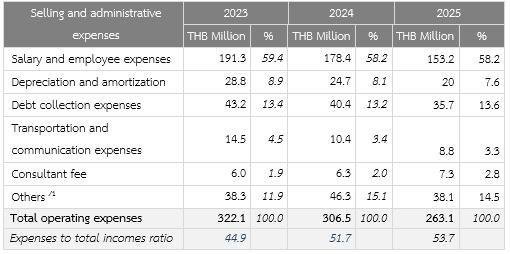
Table 6 Selling and administrative expenses are the main operating expenses of the business, with the following details:
/1 The other operating expenses included utility expenses, tax expenses, fees, promotion expenses, maintenance expenses, and insurance premium etc.
In 2025, selling and administrative expenses increased by Baht 43.4 million, representing 14.2%. The main result is decreased salary and employee-related expenses in the 2025, amounting to Baht 25.2 million, accounted for 14.1% from the previous year. This decrease was mainly due to the reduction in the number of personnel across various departments to support the downsizing of business. Additionally, the Company and its subsidiaries reduced debt collection expenses by Baht 4.7 million, accounted for 11.6% from the previous year, due to the more efficient management of follow-up fee expense. However, the expenses decreased less than the reduction in income, resulting in an increase in the ratio of selling and administrative expenses to net income after financial expenses, rising from 51.7% in 2024 to 53.7% in 2025.
• Credit cost
Table 7 Credit costs includes expected credit loss and loss from assets foreclosed, with the following details:
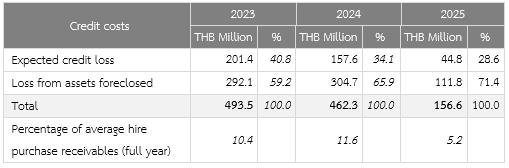
In 2025, the Company and its subsidiaries have credit costs at 5.2% of average hire purchase receivables, an decrease from 11.6% in 2024. This was due to the downsizing of the second-hand trucks hire purchase portfolio, as the Company tightened its credit screening processes in response to the slowdown in the economy, the decline in the exports and geopolitical issues that affect fuel prices. As a result, some hire-purchase customers started to default on debt payment and requested to return their vehicles. Additionally, in 2025, the Company adjusted its the price of used trucks to align with the decrease in the market price of second-hand trucks.
• Expected credit loss
Table 8 Expected credit loss
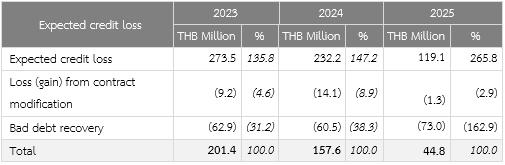
In 2025, the expected credit loss of the Company and its subsidiaries decreased Baht 112.8 million from the year 2024, representing 71.6%. The main reason for this the decline in second-hand truck hire purchase portfolio, as the company carefully tightened its credit screening processes due to the slowdown in the economy. The Company and its subsidiaries have non-performing loans to total loan receivables were 4.04% in 2025 and 4.94% in 2024. The Company and its subsidiaries have a policy to make additional write-offs for debtor who has been unable to seize their collateral and are on the process of legal proceedings with overtime. However, in the year 2024 – 2025, bad debt recovery of the Company and its subsidiaries was Baht 62.9 million, Baht 60.5 million, and Baht 73.0 million respectively. Due to the Company and its subsidiaries have a policy for debt collection officers to obtain cash inflows after bad debt write-off or repossess process.
• Loss from assets foreclosed
Table 9 Loss from assets foreclosed
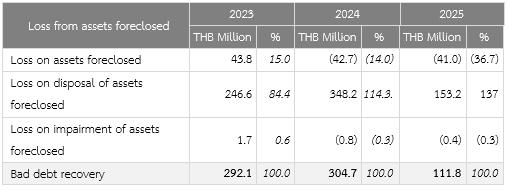
Table 10 Table presented the confiscated and sold vehicles during the year
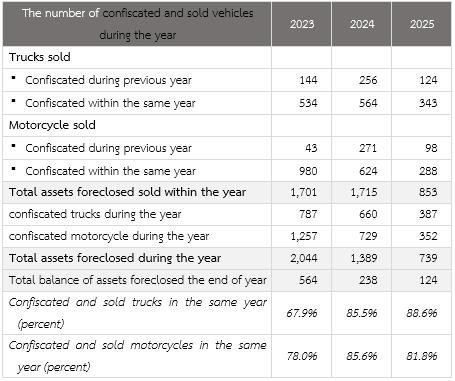
Loss from assets foreclosed include 1) Loss on assets foreclosed was the expected loss on disposal of assets foreclosed which have not yet been sold at the end of that year as present in the assets foreclosed stated in the financial statements at the end of the year reflected the appropriate value that the Company expected to receive. 2) Loss on the disposal of assets foreclosed was the gain/loss really incurred from the disposal of confiscated assets foreclosed during the year. The gain/loss on the disposal of confiscated assets foreclosed was related to the speed of the disposal and the number of assets foreclosed confiscated during the year, that is, if in any period, the number of assets foreclosed confiscated and sold was high, the gain/loss on the disposal of foreclosed assets would be high as well. The gain/loss on disposal of confiscated assets foreclosed was calculated by directly comparing sale price with the outstanding debt. 3) The loss on impairment of assets foreclosed was an estimate of expected losses of assets foreclosed which have not yet been sold, which have a long aging of assets foreclosed from the date of confiscation
• Financial cost
Table 11 Financial expenses
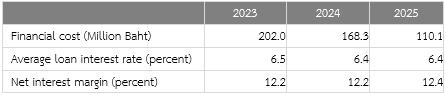
Financial expenses were one of the main costs of the company and its subsidiaries’ businesses, consisting of interest expense of various types of borrowings. The decrease in financial costs was in line with the reduction in the interest-bearing debt of the Company and its subsidiaries. However, the continuous increase in the policy interest rate has led to the increase in interest rates on bank loans and new debentures.
Net profit (loss) for the year
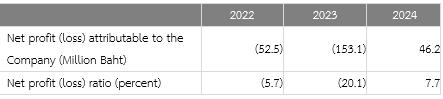
Net profit (loss) attributable to the Company for the year 2025 was Baht 46.2 million, compared to the same period of the previous year was Baht (153.1) million, The net loss increased by Baht 199.4 million or 130.2%, due to the deterioration in loan quality, decreased debt collection expenses and a higher quantity of assets foreclosed, driven by the slowdown in the economy and the decrease in the market prices of second-hand trucks.
Table 12 Net profit (loss) attributable to the Company
Liquidity & Capital Adequacy
The Company and its subsidiaries disclosed the details of Liquidity and capital adequacy under section “Corporate Group Structure and Business Operation” and sub-section “Product or service sourcing and conditions required to comply with loan agreements from financial institutions”.
Asset Management Capability
Financial Position Analysis
Table 13 Total assets of the Company
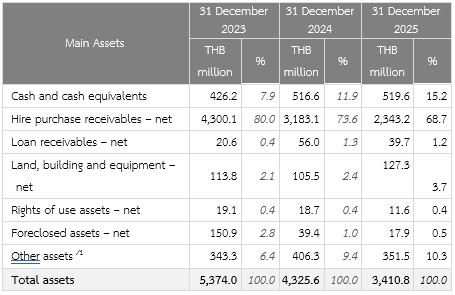
Total assets of the Company and its subsidiaries at the end of 2023 - 2025 amounted to Baht 5,374.0 million, Baht 4,325.6 million, and Baht 3,410.8 million, respectively. The decrease in total assets in year 2024 was due to the contraction of hire purchase receivables amid the economic slowdown. Therefore, the Company focuses on controlling a quality loan portfolio by tightening the credit review process, which was the significant asset of the Company and its subsidiaries.
Hire purchase receivables.
Table 14 hire purchase receivables
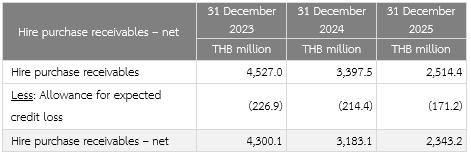
The net of hire purchase receivables (less of allowance for expected credit loss) of the Company and its subsidiaries at the end of 2023 - 2025 amounted to Baht 4,300.1 million, Baht 3,183.1 million, and Baht 2,343.2 million, accounted for 80.0%, 73.6% and 68.7% of total assets, respectively. The details were as follows;
At the end of 2024, the Company and its subsidiaries had a net decrease in hire purchase receivables of Baht 1,117.0 million, or 26.0% from the end of 2023. At the end of 2025, net hire purchase receivables decreased by Baht 839.9 million, or 26.4% from the end of 2024. The company focuses on controlling a quality loan portfolio by tightening the credit review process.
Quality of receivables of the Company and its subsidiaries
Table 15 Quality of receivables of the Company and its subsidiaries
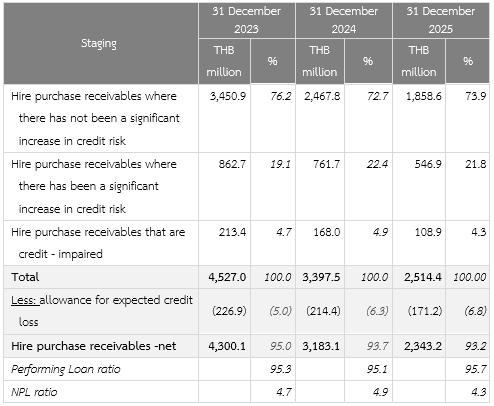
The Company and its subsidiaries classified the credit risk of each receivable under Thai Financial Reporting Standard 9 (TFRS9) to assess the quality and manage of the receivables. The receivables as of 31 December 2023 - 2025 were classified by state of credit risk as follow;
The adequacy of the Company and its subsidiaries’ allowance for expected credit loss
The Company and its subsidiaries have classified its receivables according to the classification standard and the reserve setting by new criteria according to the TFRS9 principles. The Company and its subsidiaries’ hire purchase receivables were reclassified into 3 levels as follows;
Level 1 - Receivables that do not have significant increase in credit risks, such as receivables without outstanding debt or with not more than 30 days outstanding according to the old criteria.The value of allowance for credit loss shall be measured by the expected credit loss in the next 12 months.
Level 2 - Receivables which have significant increase in credit risks, such as receivables with 31-90 days outstanding according to the old criteria.The allowance for credit loss shall be measured by the Lifetime Expected Credit Loss.
Level 3 - Receivables with credit impairment or, if considered by old criteria, receivables with more than 90 days outstanding and debtors under the process of prosecution and have not yet been written off from accounting. The allowance for credit loss shall be measured by the Lifetime Expected Credit Loss.
In consideration of allowance for impairment according to TFRS9 principles, the Company will set the allowance for the Expected Credit Loss (ECL), which is calculated by referring to the current value of total expected loss cash flow which is estimated by referring to information and experience in the past of the loss of receivable group considered to have the same characteristics of credit risk and will consider the risk from the Macroeconomic Assumption factor. However, the company regularly reviews and revises the methods, assumptions, and forecasts of future economic conditions. Additionally, the expected credit losses also include management overlays due to potential limitations of the model.
For the subsidiaries engaged in providing car title loans and unsecured personal loans, which began lending during 2023, and the subsidiary engaged in motorcycle hire purchase, which began lending during 2022, there is no historical loss data available. Therefore, the expected credit losses are based on the average historical loss data of companies in the same industry, adjusted with management overlays.
At the end of 2023 – 2025, the ratio of allowance for expected credit loss to non-performing loans (NPLs) of the Company and its subsidiaries were 106.3%, 127.7%, and 157.2%, respectively. This reflects the adequacy of the allowance for expected credit losses of the company and its subsidiaries.
Assets Foreclosed
Table 16 Assets foreclosed
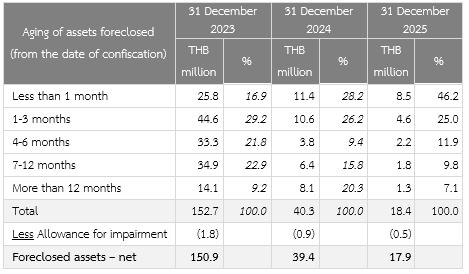
Assets foreclosed of the Company and its subsidiaries such as trucks and motorcycles repossessed from contractual customers’ default. The assets foreclosed were presented in the financial statements with the costs less the allowance for impairment (if any). At the end of 2022 – 2024, the Company and its subsidiaries had assets foreclosed - net. The details were as follows:
At the end of 2024, net foreclosed assets increased by Baht 111.5 million, or 73.9% from the end of 2023. This was partly due to an increase in the number of contracts closed from repossessed vehicles, mainly caused by rising oil prices and the economic slowdown. At the end of 2025, net foreclosed assets decreased by Baht 21.5 million, or 54.6% from the end of 2024, due to a reduction in the number of repossessed vehicles.
Land, building, and equipment
Table 17 Land, building, and equipment
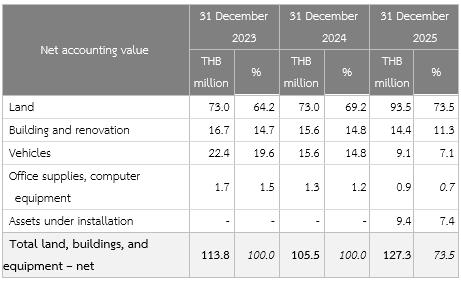
At the end of 2023 - 2025, land, building, and equipment of the Company and its subsidiaries, detail as follow;
In 2025, the company's land, buildings, and equipment decreased by Baht 21.8 million, or 20.7% from the end of 2024. In 2024, they decreased by Baht 8.3 million, or 7.3% from the end of 2023. The main reasons were annual depreciation and the disposal of assets during the year.
Rights of use assets
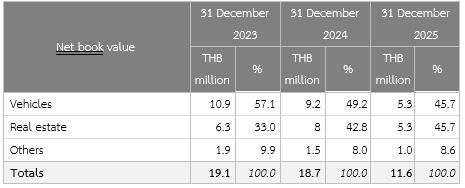
Table 18 At the end of 2023 - 2025, rights of use assets of the Company and its subsidiaries, detail as follows;
Liabilities
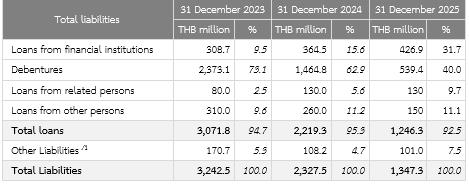
Table 19 At the end of 2023 - 2025, total liabilities of the Company and its subsidiaries amounted to
Baht 3,245.2 million, Baht 2,327.5 million, and Baht 1,347.3 million, respectively, detail as follows;
Loan from financial institutions
Table 20 Loan from financial institutions
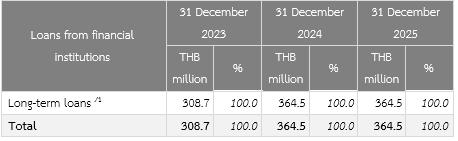
At the end of 2023 - 2025, the Company and its subsidiaries had balance of short-term and long-term loan from financial institutions amounted to Baht 308.7 million, Baht 364.5 million and Baht 426.9 million, respectively. The types of short-term and long-term loans are as follows:
At the end of 2024, loans from financial institutions increased by Baht 55.8 million, or 18.1% compared to 2023. At the end of 2025, they increased by Baht 62.4 million, or 17.1% compared to 2024. This was due to the company obtaining additional long-term loans from financial institutions during the year to support the expansion of its hire purchase loan portfolio, along with the gradual repayment of loans from financial institutions.
Debenture
At the end of 2023 - 2025, the Company had issued name registered, unsubordinated, unsecured and bond holder representative debentures amounted to Baht 2,373.1 million, Baht 1,464.8 million and Baht 539.4 million, respectively, accounted for 73.1%, 62.9% and 40.0%, respectively, of total liabilities. The details are as follows;
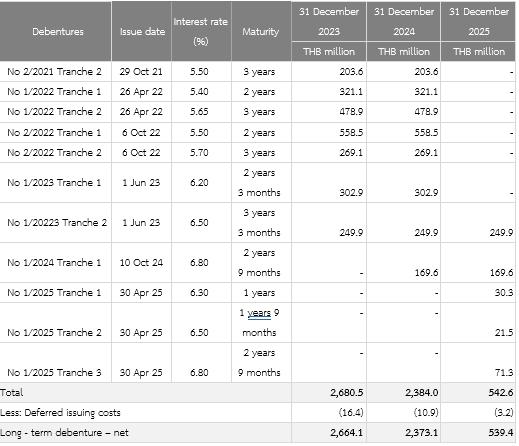
Table 21 Debenture
Loans from related persons
Loans from related persons were borrowed from directors, shareholders, and related persons with them. At the end of 2023 - 2025, the Company and its subsidiaries had balance of loans from related persons were Baht 80.0 million, Baht 130.0 million, and Baht 130.0 million, respectively. They were divided into short-term loans and long-term loans as follows:
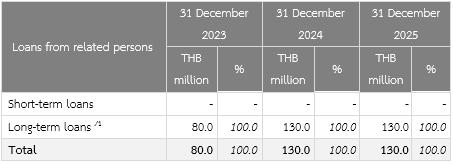
Table 22 Loans from related persons
At the end of 2024, loans from related parties increased by Baht 50.0 million, or 62.5% compared to 2023. At the end of 2025, there is no change compared to 2024. This was due to the reclassification of the item from loans from others to loans from related person , along with the subsidiary began operating a lending business, additional funding sources have been arranged to expand the loan portfolio.
Loans from other persons
Cash flow and liquidity analysis
At the end of 2024, loans from other persons decreased by Baht 50.0 million, or 16.1% compared to 2023. At the end of 2025, they decreased by Baht 110.0 million, or 42.3% compared to 2024. This was due to the reclassification of the item from loans from others to loans from related person , along with the subsidiary began operating a lending business, additional funding sources have been arranged to expand the loan portfolio.
Shareholders’ equity
At the end of 2023 - 2025, shareholders’ equity of the Company and its subsidiaries amounted to Baht 1,879.2 million Baht 1,736.8 million, and Baht 1,787.4 million, respectively. The retained earnings in 2023 - 2025 amounted to Baht 571.4million, Baht 429.0 million and Baht 477.4 million, respectively.
Cash flow and liquidity analysis
The change in cash flow of the Company and its subsidiaries during the year 2023 -2025 were summarized as follows:
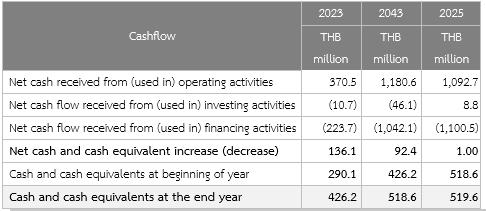
Table 24 Cash flow and liquidity analysis
During the year 2023 - 2025, the Company and its subsidiaries had a profit (loss) before tax amount to Baht 98.3 million, Baht 176.4 million, and loss of Baht 70.4 million, respectively.
The company and its subsidiaries had net cash from operating activities of Baht 370.5 million, Baht 1,180.6 million and Baht 1,092.7 million In 2023 and 2025, respectively. The cash flow used for the expansion of hire purchase receivables of the company and its subsidiaries increased by Baht 644.8 million in 2023. However, in 2024 and 2025, the Company adopted a cautious lending policy to mitigate credit quality risks, resulting in a decrease in hire purchase receivables by Baht 346.7 million and Baht 416.6 million, respectively. Additionally, there was an increase in cash flow from foreclosed assets, consistent with the number of repossessed vehicles each year.
Net cash used in investing activities of the Company and its subsidiaries in 2023 - 2024 was Baht 10.7 million and Baht 46.0 million, respectively. The main reasons were an increase in purchases of land, buildings, and equipment, Intangible assets amounting to Baht 11.4 million, Baht 9.1 million, respectively. In 2024 increase in bank deposits of Baht 60.0 million and decrease in bank deposits with collateral of Baht 23.0 million. In 2025 decrease in bank deposits of Baht 60.0 million, increase in bank deposits with collateral of Baht 20.0 million and decrease from purchases of land, buildings, and equipment, Intangible assets amounting to Baht 31.4 million.
Net cash used in financing activities of the company and its subsidiaries in 2023 - 2025 was Baht 223.7 million, Baht 1,042.1 million and Baht 1,100.5 million, respectively. The main reason in 2023 - 2025 there were repayments of matured debentures amounting to Baht 849.0 million, Baht 1,083.2 million and Baht 1,051.0 million, respectively.
Liquidity and capital adequacy
The Company and its subsidiaries disclosed the details of Liquidity and capital adequacy under section “Corporate Group Structure and Business Operation” and sub-section "Product or service sourcing and conditions required to comply with loan agreements from financial institutions”.
Liabilities commitments and management of Off-balance sheet liabilities
The Company and its subsidiaries disclosed the details of commitment under section 34 of the notes to the consolidated financial statement for the year ended 31 December 2025.
Debt Obligations & Off-Balance-Sheet Management
The Company and its subsidiaries disclosed the details of commitment under section 34 of the notes to the consolidated financial statement for the year ended 31 December 2025.
Material & Related-Party Transactions
Loans from related persons
Loans from related persons were borrowed from directors, shareholders, and related persons with them. At the end of 2023 - 2025, the Company and its subsidiaries had balance of loans from related persons were Baht 80.0 million, Baht 130.0 million, and Baht 130.0 million, respectively. They were divided into short-term loans and long-term loans as follows:
At the end of 2024, loans from related parties increased by Baht 50.0 million, or 62.5% compared to 2023. At the end of 2025, there is no change compared to 2024. This was due to the reclassification of the item from loans from others to loans from related person, along with the subsidiary began operating a lending business, additional funding sources have been arranged to expand the loan portfolio.
Debt Securities with Financial Ratio Requirements
Debt Securities with Financial Ratio Requirements Issued?
Yes
Can the Company Maintain the Reported Financial Ratios?
Yes
Explanation
According to the bondholder rights terms, the bond issuer will maintain a ratio of "total liabilities" to "shareholders' equity" at the end of the fiscal year of the consolidated financial statements throughout the bond tenure, at a ratio not exceeding 3:1 (three to one).
The financial ratio specified in the bondholder rights terms is 0.61 : 1 (in accordance with the specified rights terms).
Factors That May Affect Financial Condition
Factors or Incidents That May Materially Affect Financial Condition
Business Operations, Economy, and Industry Conditions Affecting Operations
In 2025, the Company maintained its liquidity policy, emphasizing the screening of new debt quality, maintaining the quality of its loan portfolio, and effectively managing costs. The Company's total revenue decreased by 21.10% (YoY). Total expenses decreased by 45.41% (YoY) due to reduced sales and administrative expenses and credit losses, which aligned with proactive asset quality management and reduced financial costs from loans from financial institutions, debentures at maturity. Resulting The Company's net Profit attributable to shareholders amounted to Baht 46.22 million, an increase of 130.18% (YoY) compared to the same prior year.
In 2025, the Company had a total outstanding loan portfolio of Baht 2,558.11million, a decrease of 26.01% (YoY) in line with strict loan approval policies. The Company continued to focus on loan quality, maintaining a non-performing loan (NPL) ratio of 4.35%, within the target control range of not exceeding 5%, and increased from the prior year 4.94% due to economic conditions recovering more slowly than expected and the slowdown in loan disbursement volumes. However, the increase was occurring at a slower rate, reflecting the Company's cautious loan disbursement and proactive risk management. The NPL coverage ratio remained strong at 157.53%.
Expected credit losses in 2025 decreased by 112.90% (YoY) according to the downsize of hire purchase account receivable portfolio on controlling quality of loans by increase in the strictness of new loan approval consideration. So The Company continued to emphasize efficient business operations within a stringent risk management framework.
Factors that May Affect Future Operations or Growth
Although the global economy may not enter a recession in 2026, the growth generated is fraught with vulnerabilities in several dimensions. The Thai economy still has potential for growth in 2026, but this growth will be accompanied by several vulnerabilities stemming from slowing domestic and international demand. Several research centers estimate Thai economic growth at 1.5-1.8%, primarily driven by domestic stimulus and tourism promotion. However, Thai merchandise exports are expected to contract this year, reducing a key driver of the Thai economy. Public and private investment is also projected to slow. Political clarity will help Thailand navigate this crisis. The financial sector continues to face challenges such as household vulnerability and high levels of household debt, tighter lending practices by financial institutions, and a continued downward trend in loan growth. These are potential future events that could impact company performance.
Sustainability Development
Sustainability concerns are now a major business opportunity as well as a risk. Businesses can grow sustainably by adhering to good governance principles, taking social and environmental responsibility into account, and disclosing information in accordance with trustworthy standards.
The Company has set sustainable development goals in line with the United Nations Sustainable Development Goals (SDGs), adhering to good corporate governance principles. It emphasizes all stakeholders and considers changing economic, social, and environmental contexts impacting the Company. The sustainability strategy includes risk management in all dimensions, such as recognizing and addressing environmental impacts from business operations and services and efficient resource utilization.
Detailed information can be found in the annual report, Form 56-1, under the section "Driving Business for Sustainability."